
Photo © Claudio Mota
**This article is a direct feature from the September/October 2025 My French Country Home magazine written by Madeleine Piggott. To see more articles like this, be sure to subscribe to the magazine**
Grotesque. Gruesome. Hardly words you’d associate with Paris. And yet, above the city center’s crowded cafés, intricate façades and zinc rooftops, something darker broods. Perched among the soaring spires of the Notre-Dame Cathedral, you’ll find the city’s most unlikely guardians — a strange parliament of monsters, leering, smirking, sometimes sulking — and ever watching.
SUBSCRIBE TO THE MAGAZINE
Aloof and dramatic, the gargoyles of Notre-Dame have guarded this beloved French monument from both the elements and the devil himself — so they say — for more than eight centuries. Part beast, part architectural flourish, these stone creatures peer and pout from the cathedral’s rooftops or lurch from the flanks of its flying buttresses. They have weathered revolution, restoration and fire — and straddle a strange threshold, between function and fantasy, humor and horror.

What are gargoyles, really?
While commonly referred to as “gargoyles,” only a fraction of the 200 figures actually earn the name. True gargoyles — from the Old French gargouille and Latin gurgulio, meaning “throat” — are functional water spouts. Jutting starkly from the stone walls, their mouths frozen in wide grimaces, they were conceived as part of the 12th century cathedral’s original design, engineered to channel rainwater away from the delicate limestone façades and foundations, and curb the creeping spread of moss and mold.
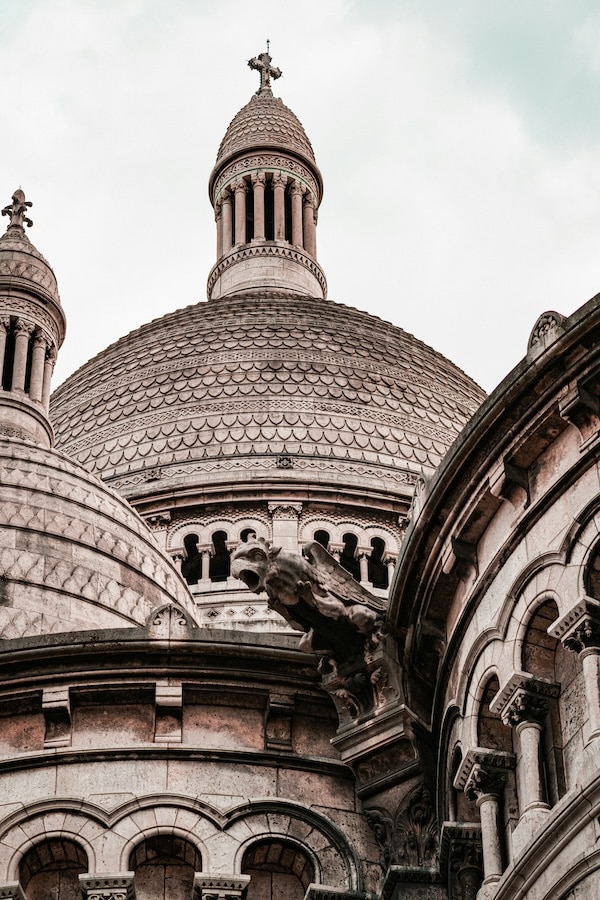

In addition to their functional role, gargoyles at Notre-Dame Cathedral were always intended as symbolic and decorative elements. With their contorted faces and menacing forms, these sculptures were designed to frighten away evil spirits and remind the faithful that sin and temptation lurked just beyond the cathedral walls. Whether as guardians or grim warnings, they served as visual sermons, reinforcing the boundary between sacred interior and the profane world outside.
Notre-Dame’s Ornamental Monsters
In truth, not all creatures atop Notre-Dame are technically gargoyles. It is mainly the grotesques and chimeras — the purely ornamental monsters — that have captured the modern imagination. Most are 19th century additions, the product of an ambitious Gothic Revival of the dilapidated cathedral, helmed by the architect Eugène Viollet-le-Duc.

Working with the sculptor Victor Geoffroy-Dechaume, Viollet-le-Duc oversaw the design of more than 50 new — highly imaginative — grotesques. Horned apes, winged dragons and owl-men: some figures draw from medieval bestiaries, others hint at France’s colonial gaze with elephantine trunks or Sphinx-like bodies.
The most famous is Le Stryge, or the Strix — a mythical demon-bird said to prey on children. Chin in hand, wings furled, gazing down in weary contemplation, this brooding figure became emblematic of Romantic melancholy — a stone analogue to Baudelaire’s flâneur: the detached urban observer suspended between irony and ennui.
The Gargoyles Today
Over time, the distinction between medieval and modern gargoyles has blurred. Viollet-le-Duc’s additions, though technically inauthentic, have long enchanted visitors and are now as emblematic of the cathedral as its rose windows.

Although most gargoyles and grotesques escaped damage in the 2019 fire, many were already suffering from erosion, pollution and structural fatigue. Several had been removed or replaced in prior decades, with further conservation planned even before the catastrophic loss of the roof and spire.
The question facing restorers was philosophical as much as practical: should Viollet-le-Duc’s 19th century vision be faithfully reproduced, be reimagined with contemporary iconography, or returned to medieval restraint? Ultimately, the French heritage agencies overseeing the project committed to restoring all architectural elements à l’identique — faithfully to their pre-fire state, using traditional methods and original materials wherever possible.

Now that Notre-Dame has reopened, the Galerie des Chimères is once again accessible via the north tower climb. (This must be booked in advance through an organized tour.) There, visitors can stand eye-to-eye with Le Stryge and pause for a moment of quiet contemplation, high above the city, in the company of these strangely beautiful stone sentries.